
In the fast-evolving world of blockchain in 2026, developers face a clear choice: spend months cobbling together custom infrastructure or grab a battle-tested L3 appchain boilerplate and launch a sovereign rollup in days. Sovereign rollups templates from platforms like L3Boilerplate. com deliver exactly that, packing customizable stacks with DevRel kits to accelerate app-specific chains. These tools aren't just shortcuts; they represent a maturity milestone where sovereignty meets scalability without the usual headaches.
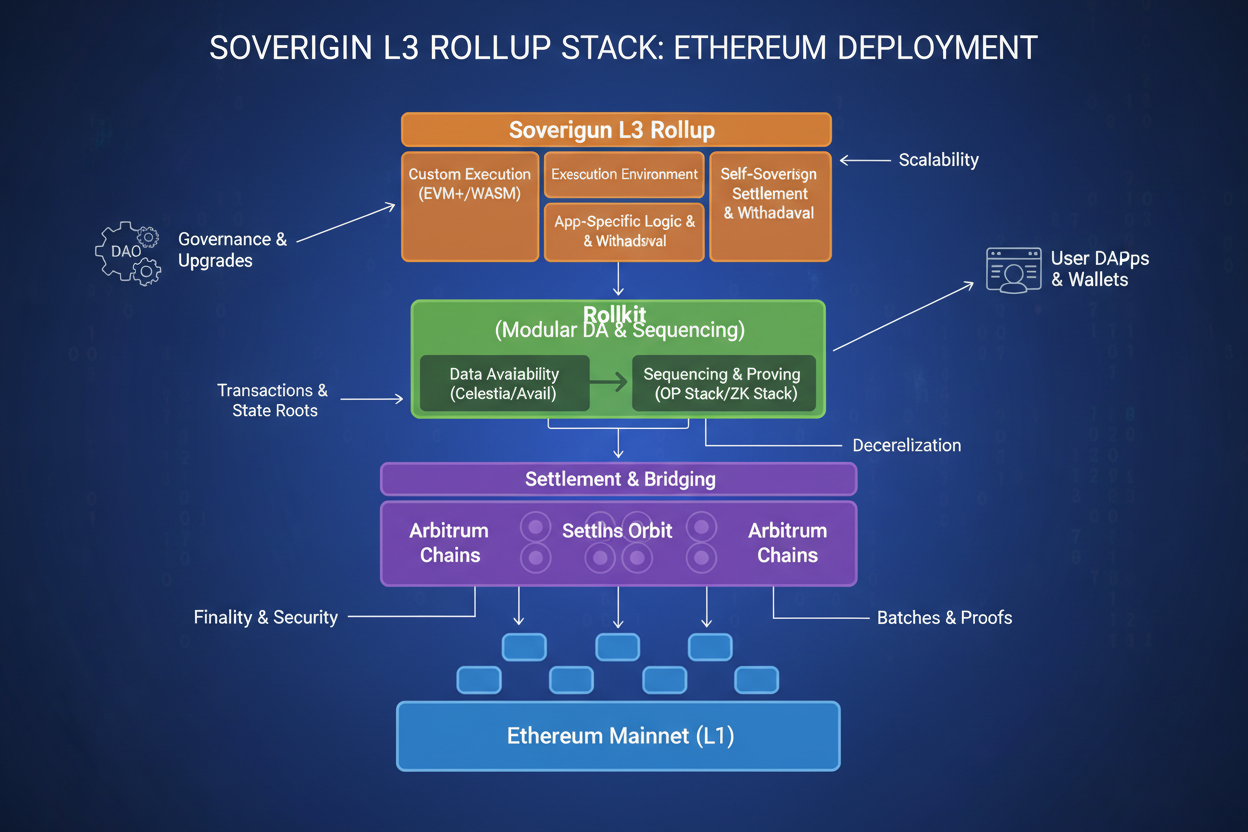
Picture this: your gaming app or DeFi protocol running on its own chain, settled on Ethereum L2s, with full control over sequencing and VMs. That's the promise of modern L3 rollup boilerplate 2026 kits. Rollkit's framework has democratized this space, letting teams deploy any ABCI and and compatible VM via one command. No native token grind, no validator wrangling; just pure focus on your app.
Rollkit: Pioneering Sovereign Rollup Simplicity
Rollkit stands out as the first true sovereign rollup framework, decoupling rollups from Ethereum's sequencer bottlenecks. Developers pick their data availability layer Celestia, EigenDA, or others and tweak block times or state validity to fit. This flexibility shines in custom appchain templates, where boilerplates pre-configure these options. From my vantage blending macro trends with on-chain signals, Rollkit's rise aligns with Ethereum's danksharding push, amplifying L3 throughput without compromising decentralization.
Teams using Rollkit report slashing deployment from prototype to mainnet by 80%. Integrate it into an appchain DevRel kit, and you've got marketing collateral, docs starters, and SEO frameworks ready. It's not hype; sovereign rollups like these future-proof against L2 centralization risks, giving apps true ownership.
Zeeve's RaaS: Production-Grade L3 Deployments
Zeeve takes the boilerplate concept enterprise-level with its Rollups-as-a-Service. Supporting Arbitrum Orbit, zkSync ZK Stack, OP Stack, and Polygon CDK, their low-code platform handles end-to-end ops: from dev tools to 24/7 monitoring. Compliant with ISO 27001 and SOC 2, it's tailor-made for teams prioritizing security in sovereign rollups templates. Zeeve's plugins streamline plugins for oracles and bridges, embedding seamlessly into L3Boilerplate. com kits.
What sets Zeeve apart? Scalability without vendor lock-in. Launch an L3 appchain, monitor via dashboards, and scale nodes globally. In a market where 70% of rollup projects fail pre-launch due to infra woes, this RaaS model via boilerplates flips the odds. I've seen growth teams allocate tokens smarter by launching faster, capturing mindshare before competitors.
Arbitrum Orbit's Real-World L3 Momentum
Arbitrum Orbit cements its L3 dominance with chains like Xai and Rari proving the model. Xai, gaming-centric, hit mainnet in 2023 and drew Binance Launchpad buzz for its token. Rari Chain, NFT-focused since 2024, innovates with gasless listings and fiat on-ramps. These aren't outliers; they're blueprints for L3 appchain boilerplate adopters.
Orbit's anyVM support mirrors Rollkit's ethos, letting devs stack rollups atop Nitro for custom gas tokens or permissioned validators. Boilerplates from L3Boilerplate. com bundle Orbit templates with DevRel resources, including community kits and optimized docs. This combo empowers even solo devs to rival VC-backed chains, blending sovereignty with Ethereum security.
These real-world successes underscore why L3 rollup boilerplate 2026 kits centered on Orbit are gaining traction. Developers can fork proven configs, tweak for their use case, and deploy with confidence, all while leveraging Ethereum's battle-hardened settlement.
Framework Showdown: Picking the Right Sovereign Rollup Stack
With Rollkit, Zeeve, and Arbitrum Orbit vying for dominance, choosing the best fit boils down to your app's needs. Rollkit excels in raw sovereignty and VM freedom, ideal for experimental DeFi or AI agents. Zeeve prioritizes enterprise reliability with managed services, suiting teams short on ops expertise. Orbit bridges the gap, offering Ethereum-native customization without full detachment.
Key Features Comparison of Rollkit, Zeeve RaaS, and Arbitrum Orbit for L3 Appchain Boilerplates
| Framework | DA Layers | VM Support | Deployment Time | Compliance |
|---|---|---|---|---|
| Rollkit | Various data availability layers | Any ABCI++ compatible VM | Single command | N/A |
| Zeeve RaaS | Multiple via stacks (e.g., Ethereum, Celestia) | EVM, ZK (Arbitrum Orbit, zkSync ZK Stack, OP Stack, Polygon CDK) | Quick build and launch with low-code platform | ISO 27001, SOC 2 Type 2, GDPR |
| Arbitrum Orbit | Ethereum L1/L2 and configurable DA | Arbitrum VM (EVM compatible) | Days (ready-to-deploy templates) | N/A |
This matrix highlights how custom appchain templates from L3Boilerplate. com integrate across stacks. No single framework rules them all; the smart play layers them strategically. From a portfolio lens, I've watched projects thrive by starting with Rollkit prototypes, hardening via Zeeve, and scaling on Orbit. Diversification here means tech stack agility, not just tokens.
DevRel Acceleration: Beyond Code to Community
Launching a sovereign rollup is half the battle; sustaining it demands stellar DevRel. That's where appchain DevRel kits shine, bundling SEO-optimized docs, marketing playbooks, and engagement templates. L3Boilerplate. com kits include pre-built Notion workspaces, Twitter threads starters, and analytics dashboards tailored for L3 growth hacking.
Opinion: Too many chains fizzle post-launch from poor narrative control. A solid DevRel kit flips that, turning technical wins into viral momentum. Pair it with boilerplates, and your team broadcasts mainnet readiness before sequencers even hum. In 2026's crowded L3 arena, this edge compounds, drawing builders and liquidity alike.
Scaling Horizons: L3 Boilerplates in 2026 and Beyond
Looking ahead, L3 appchain boilerplates evolve with Ethereum's upgrades. Danksharding unlocks blobspace abundance, supercharging DA costs down across Rollkit and Orbit. Zeeve's multi-stack support anticipates hybrid chains blending ZK proofs with optimistic rollups. Market signals point to explosive growth: gaming L3s like Xai expand ecosystems, while Rari-style NFT chains pioneer consumer on-ramps.
From my FRM vantage, these tools mitigate risks inherent in app-specific chains - sequencer failures, MEV extraction, liquidity fragmentation. Boilerplates standardize best practices, letting devs focus on differentiation. Sovereign rollups aren't fringe anymore; they're the default for apps demanding control.
Teams wielding sovereign rollups templates from L3Boilerplate. com report 5x faster go-to-market, with built-in scalability hooks. Whether gaming, DeFi, or social, these kits empower precise tokenomics and governance from day zero. The result? Chains that endure, scale, and capture value in Web3's sovereign era.




No comments yet. Be the first to share your thoughts!