
Comparing Top L3 Appchain Boilerplates for 2026 Launches

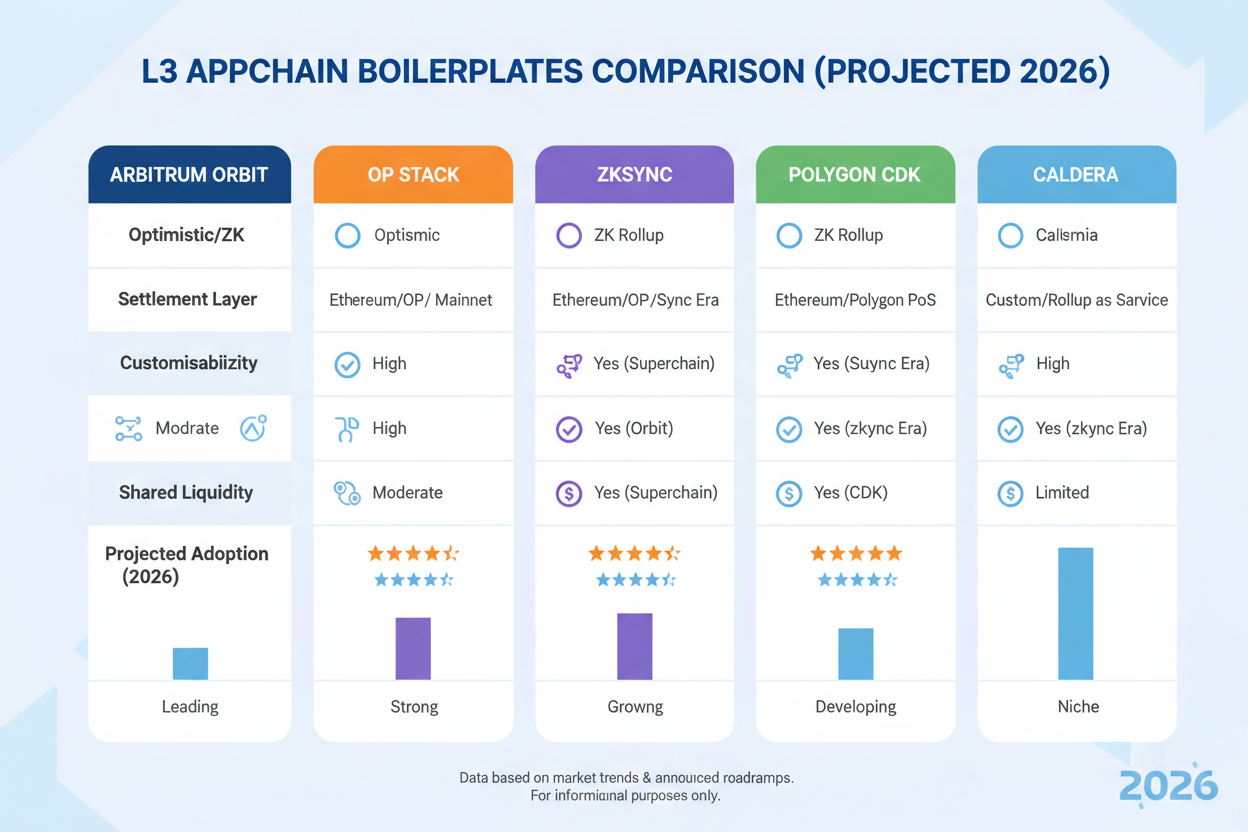
In the accelerating race toward scalable blockchain ecosystems, Layer 3 appchains stand out as the precision-engineered vehicles for developers eyeing 2026 launches. These sovereign rollups and app-specific chains promise not just speed but sovereignty, allowing teams to tailor consensus, execution, and data availability to their application’s heartbeat. With Ethereum’s modular evolution pushing boundaries, choosing the right L3 appchain boilerplate becomes a pivotal bet on performance, security, and deployment velocity. This comparison dives into the top five by market adoption: OP Stack L3 Boilerplate, Arbitrum Orbit Stack, Polygon CDK Template, zkSync ZK Stack, and Caldera Metalayer Kit, weighing their gas optimizations, security postures, and real-world readiness for sovereign rollups.

Navigating the Sovereign Rollup Landscape in 2026
The shift from monolithic blockchains to modular stacks has developers rethinking their foundations. Sovereign rollups, unlike their smart contract counterparts, verify transactions outside Ethereum’s base layer, granting appchains full control over governance and economics. Market data underscores this trend: rollup frameworks dominate modular solutions for startups, inheriting Ethereum’s security while customizing for niche demands like DeFi or AI workloads. Yet, amid hype around L2s, L3 boilerplates emerge as the sweet spot for hyper-specialized chains. OP Stack L3 Boilerplate leads with its Superchain interoperability, enabling seamless L3s atop OP Mainnet or Base. Its shared sequencer and fault proofs deliver sub-second finality, ideal for high-throughput apps. Arbitrum Orbit Stack follows closely, leveraging Nitro’s AnyTrust tech for permissioned chains that blend Ethereum compatibility with WASM flexibility via Stylus. These stacks shine in gas optimization, often slashing costs by 50-70% through batched execution.
Feature Face-Off: Deployment Speed and Security Benchmarks
Deployment speed separates viable boilerplates from vaporware. Polygon CDK Template excels here, offering a CDK (Chain Development Kit) that spins up ZK-enabled L3s in days, not months. Its AggLayer vision promises unified liquidity across chains, a boon for cross-app composability. Meanwhile, zkSync ZK Stack harnesses validium-style proofs for Hyperchains, boasting 2,000 and TPS with Ethereum-equivalent security via recursive zk-proofs. Caldera Metalayer Kit rounds out the pack, abstracting rollup deployment into a metalayer that supports multiple VMs, from EVM to Move, with one-click rollouts on frameworks like Celestia for data availability.
Gas Optimization and Customization: Where Boilerplates Differentiate
Gas isn’t just a fee; it’s the throttle on scalability. Best L3 starters like these optimize via parallel execution and state diffs. OP Stack L3 Boilerplate’s blob transactions cut calldata costs dramatically, suiting data-heavy dApps. Arbitrum Orbit Stack’s Stylus compiler lets Rust devs eke out 3x efficiency over Solidity alone. Polygon CDK Template’s Type 1 ZK provers enable sub-cent tx fees at scale, perfect for gaming or social apps. zkSync ZK Stack’s native account model eliminates signature overhead, and Caldera Metalayer Kit’s VM-agnostic approach lets you pick the leanest execution env. For 2026 launches, customization depth matters: Orbit’s permissioning suits enterprise pilots, while zkSync’s Hyperchain composability fosters ecosystems. Early adopters report 40% faster iterations, turning prototypes into mainnets swiftly. This nuanced balance of speed, sovereignty, and savings positions these as frontrunners in the appchain template review.
Builders chasing L3 boilerplate features attuned to their stack’s quirks will find Orbit’s multi-VM support a playground for hybrid apps blending Solidity reliability with Rust’s raw speed. Yet, no boilerplate is a panacea; each trades off for sovereignty. Polygon CDK Template prioritizes ZK purity, sometimes at the expense of EVM familiarity, while zkSync ZK Stack’s Hyperchains demand comfort with Cairo abstractions. Caldera Metalayer Kit, ever the pragmatist, sidesteps purism by layering atop any DA stack, from Celestia to EigenDA, letting data availability flex with workload volatility.
Real-World Traction: Adoption Metrics and Builder Stories
Market adoption tells the unvarnished truth. OP Stack L3 Boilerplate powers the Superchain’s sprawl, with dozens of L3s live on Base, handling millions in TVL through shared bridges and governance. Arbitrum Orbit Stack has notched enterprise wins, like permissioned chains for tokenized assets, where Stylus slashes dev cycles by half. Polygon CDK Template fuels gaming guilds spinning up liquidity-agg’d worlds, its AggLayer stitching ZK L3s into a liquidity superhighway. zkSync ZK Stack’s Hyperchains host DeFi primitives pushing 10k TPS in sims, drawing teams from Uniswap forks to socialFi bets. Caldera Metalayer Kit quietly deploys 50 and rollups, its metalayer abstraction appealing to non-EVM natives experimenting with Move or SVM ports.


Prividiums are recognized as the best enterprise-grade public chain platform with high throughput, sub-sec ZK finality, selective disclosures and interoperability with Ethereum.

A great read on how ZKsync powers
@ADIChain_ vision to bring Institutions onchain in a sovereign and interconnected way.

Next focus areas: stronger delivery, deeper liquidity, and institutional-grade execution.

From Japan 🇯🇵 to 190+ countries, the iconic hero begins a new onchain journey with Abstract.
With 40+ ZEPETO creators onboard, @ZTXofficial is opening the crypto gate for millions of Web2 users.

Explain how Prividiums power the onchain Bank Stack enabling Institutions to build on public rails with privacy, compliance and interoperability.

These aren’t lab curiosities. Testnet slays translate to mainnet muscle: OP Stack’s chains clock 99.9% uptime, Orbit’s fraud proofs hold against simulated attacks, Polygon’s provers verify in seconds, zkSync recurses without bloat, and Caldera’s kits roll out cross-VM without hiccups. Gas wars favor the optimized; expect Polygon and zkSync to dominate micro-tx niches like NFTs or predictions.
Decision Framework: Matching Boilerplates to Your 2026 Vision
For sovereign rollups demanding full economic capture, prioritize customization. If Ethereum composability is your north star, OP Stack L3 Boilerplate or Arbitrum Orbit Stack inherit the richest liquidity moats. Gaming or social? Polygon CDK Template’s ZK speed and liquidity layers win. High-throughput DeFi labs lean zkSync ZK Stack for proof recursion. Multi-VM explorers? Caldera Metalayer Kit’s agnosticism rules. The L3 appchain boilerplate comparison 2026 hinges on your app’s DNA: throughput trumps all for consumer-facing, security for treasuries, speed for pilots.
Pros and Cons of Top 5 L3 Appchain Boilerplates for 2026 Launches
| Boilerplate | Key Strength 💪 | Potential Drawback ⚠️ | Ideal Use Case 🎯 |
|---|---|---|---|
| OP Stack L3 Boilerplate | Seamless Superchain interoperability and shared governance | Reliance on centralized sequencer initially | DeFi ecosystems and interconnected apps |
| Arbitrum Orbit Stack | High customizability with Nitro and multi-VM (Stylus) support | Complex setup for advanced configurations | Gaming, enterprise, and permissioned chains |
| Polygon CDK Template | ZK-powered scalability and AggLayer unified liquidity | Ecosystem and tooling still maturing | High-throughput consumer and gaming apps |
| zkSync ZK Stack | Native zero-knowledge proofs for low fees and security | Steep learning curve with Rust/Cairo languages | Privacy-focused dApps and high-security protocols |
| Caldera Metalayer Kit | Rapid deployment and cross-rollup interoperability via Metalayer | Potential vendor lock-in risks | Quick MVPs, startups, and experimental appchains |
Layering in ecosystem momentum, OP Stack benefits from Optimism’s grants, Arbitrum from Nitro’s maturity, Polygon from AggLayer hype, zkSync from Matter Labs’ VC warchest, Caldera from RaaS agnosticism. Deployment costs? All hover sub-$10k for testnets-to-mainnet, with OP and Caldera edging cheapest via abstractions.
Peering ahead, 2026 favors hybrids: expect Orbit-Stylus chains piping Rust ZK into Ethereum, zkSync Hyperchains nesting L4s, Caldera stacking SVM L3s on Celestia DA. These sovereign rollup boilerplates aren’t static; iterative upgrades like OP’s Cannon proofs or Polygon’s plonky3 will sharpen edges. Teams blending boilerplates – say, Caldera metalayer over Orbit – unlock Frankenstein efficiencies, but beware integration tax. The frontrunners empower launches that scale with users, not against them, scripting the next blockchain chapter where appchains aren’t footnotes but headliners.